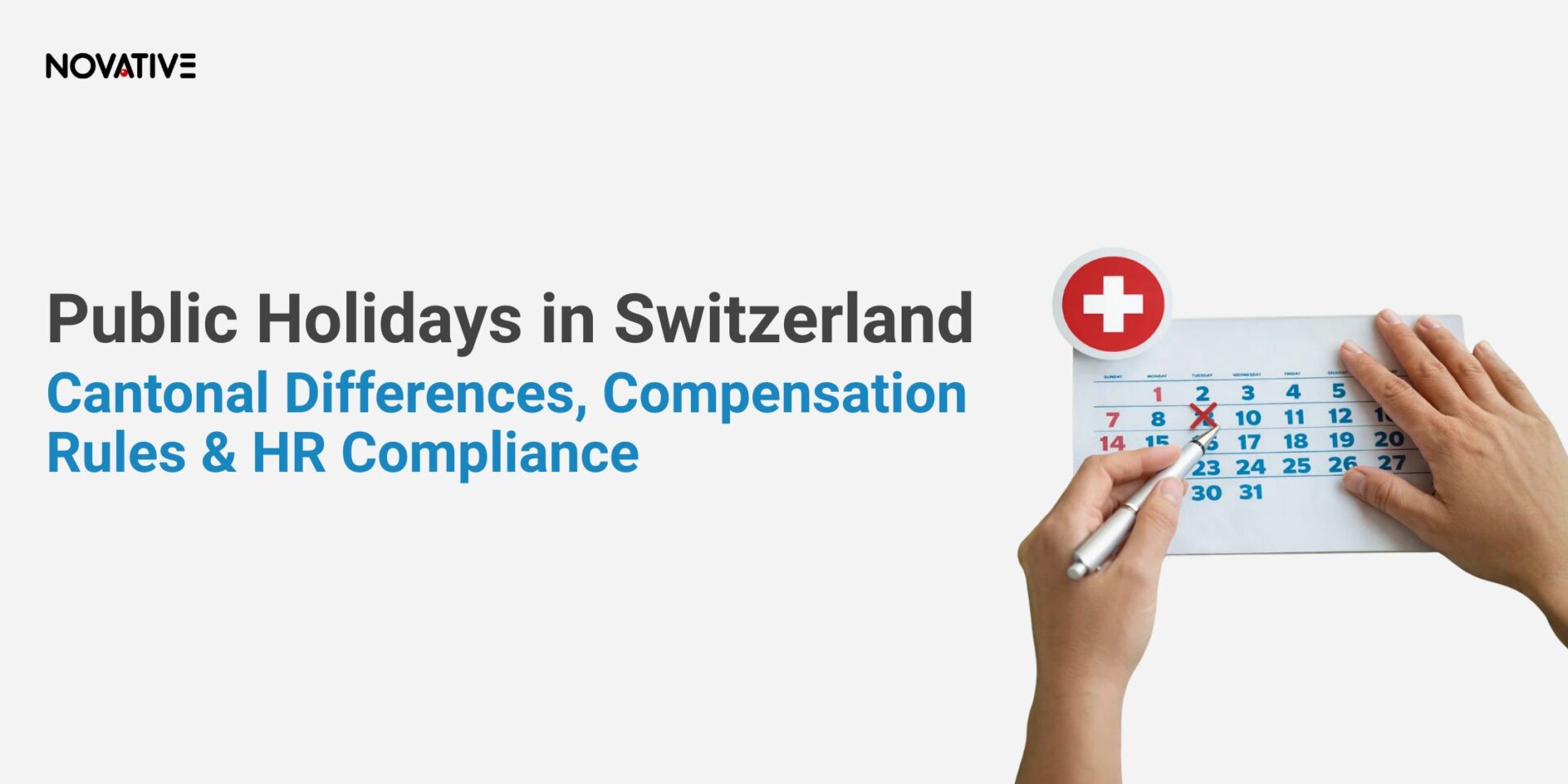
In Switzerland, most public holidays are decided at the cantonal level rather than nationally. The only federal public holiday is Swiss National Day on August 1. As a result, holidays and related rules can vary depending on the canton and, in some cases, the employee’s status.
In this blog post, we will share a list of public holidays in Switzerland, show which cantons observe each holiday, explain how this can affect payroll, and discuss how technology can help companies operating across multiple cantons.
Swiss Public official Holidays by Canton
Switzerland’s Unique Public Holiday System
Swiss federal law requires employers to provide pay for up to 9 public holidays per year of 9 paid public holidays per year, including August 1st. However, many cantons observe additional holidays for religious, historical, or cultural reasons, so the total number of holidays celebrated locally can range from 12 to 15 days. Whether the extra holidays are paid or unpaid depends on cantonal rules, collective agreements, or the employer’s policy.
In principle, working on public holidays is prohibited. If a company requires employees to work on a public holiday, it must follow the same procedure as for Sunday work and submit an application for legal authorization. However, for certain professions and types of work, no authorization is required. The State Secretariat for Economic Affairs provides an up-to-date list of occupations that are exempt from authorization for night work and work on Sundays.
Compensation for Employees Working on Holidays
Temporary holiday & Sunday work is limited to a maximum of six days per calendar year. For these temporary shifts, employees are entitled to a 50% wage supplement In addition to time off in compensation that varies depending on the number of hours worked:
- Five hours or less: entitled to take time off of the same duration within four weeks.
- More than five hours: entitled to one day of rest of at least 24 consecutive hours (in addition to the daily rest), during the current or the following week.
If an employee works more than six Sundays in a year, the work is considered regular or periodic Sunday work. In this case, employees must receive hourly compensation and compensatory rest, as defined under Art. 20 of the Swiss Labor Act (LTr), which regulates working hours and mandatory rest periods.
Public Holidays During Annual Leave
One aspect that is often overlooked concerns the interaction between public holidays and annual leave. If a public holiday falls during an employee’s vacation period, it is not counted as a vacation day.
In other words, employees do not “lose” a vacation day when an official public holiday coincides with their approved annual leave. That day is treated as a public holiday and therefore is not deducted from the employee’s vacation balance.
This ensures that employees receive at least the minimum vacation required by Swiss employment law. That said, companies should also check whether any rules in a collective labor agreement (CLA) or their own internal policies might apply.
Public Holidays During Annual Leave
How HR Technology Helps Manage Public Holidays in Switzerland
Managing public holidays in Switzerland can be challenging, given the differences between cantons, and the regulations around working on Sundays and holidays. HR technology such as Nova Smart NG makes this process seamless and efficient through:
Automating Holiday Calendars
A smart HR system can automatically populate national and cantonal public holidays for each employee based on location.
Calculating Compensation Accurately
It helps you track the exact number of hours worked on public holidays and Sundays, automatically apply the appropriate rest periods, and calculate wage supplements such as overtime or holiday premiums.
Ensuring Legal Compliance
An HR software can flag when work requires official approval and tracks compliance with maximum hours and rest periods.
Reporting and Analytics
HR technology provides detailed reports on holiday work, overtime, and compensation, helping HR and finance teams streamline budgeting, audits, and employee communications
Switzerland’s cantonal public holiday system requires employers to carefully manage varying rules on pay, authorization, and compensation. Understanding the legal framework is essential to ensure compliance and fair treatment of employees.
With the right HR technology, companies can simplify holiday tracking, automate compensation rules, and stay compliant across cantons, reducing risk while improving efficiency.