The EU Pay Transparency Directive (Directive (EU) 2023/970) is an EU legislation designed to reduce the gender pay gap by strengthening the enforcement of equal pay for equal work or work of equal value across all 27 member states.
It establishes uniform and legally binding standards across the European Union aimed at promoting pay equity through enhanced transparency. Under Article 34, Member States must bring the necessary national measures into force by 7 June 2026 and notify them to the European Commission.
On 18 December 2025, the European Commission reaffirmed that it expects all EU member states to complete implementation by this deadline, stating that “the Pay Transparency Directive is instrumental for the full realization of the right to equal pay for the same work or work of equal value between women and men.
What are The Obligations of EU Pay Transparency Act?
Workers
The EU Pay Transparency Directive introduces new transparency and reporting requirements aimed at strengthening the principle of equal pay for equal work or work of equal value. The Directive grants new rights to job applicants and workers while imposing a range of obligations on employers to promote greater pay transparency and accountability.
Job Applicants
Applicants have the right to receive information from a prospective employer before an interview on:
- The initial pay for the job position, or its range
- Where relevant, details of the provisions of the collective agreement applied by the employer in relation to the position
Employees have the right to request information either directly, through their workers’ representatives, or through a national equality body regarding:
- Their individual pay level.
- The average pay levels, broken down by sex, for workers performing the same work or work of equal value.
Employees also cannot be prevented from disclosing their pay when doing so for the purpose of enforcing the principle of equal pay.
Employers
- May not ask job applicants about their current or previous pay,
- Ensure that vacancy notices and job titles are gender neutral and recruitment processes are non-discriminatory.
- Employers must make it easy for employees to access information about how pay, pay levels, and pay increases are determined, and the criteria used must be objective, fair, and free from gender bias.
- Inform all their employees annually of their right to request and receive in writing information on their individual pay and average pay levels broken down by sex for colleagues doing the same work or work of equal value,
- Provide gender pay gap reports to authorities, employees, and workers’ representatives, including metrics such as the overall gender pay gap and the share of men and women receiving bonuses or other variable compensation.
- Cooperate with workers’ representatives to identify, remedy and prevent discriminatory pay differences when their pay reporting reveals a gender pay gap above 5% that cannot be justified by objective, gender-neutral criteria and was not tackled within 6 months.
Where Member States Stand Today
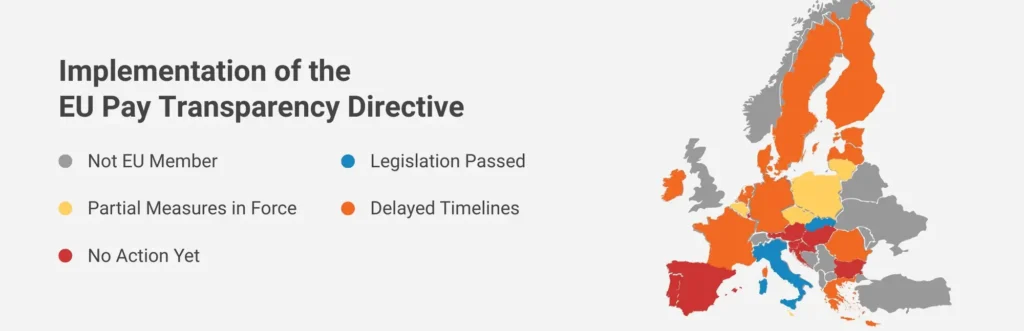
Legislation Passed (2 countries)
Slovakia and Italy were among the first EU Member States to adopt national legislation implementing the Pay Transparency Directive. On 15 April 2026, the Slovak Parliament approved the Act on Equal Pay for Men and Women, making Slovakia the first country to fully transpose the Directive. Italy followed with Legislative Decree No. 96/2026, which was published in the Official Gazette on 1 June 2026 and entered into force on 7 June 2026. Both countries have introduced binding obligations for employers covering recruitment transparency, employees’ rights to pay information, and gender-neutral pay structures, along with gender pay gap reporting requirements under the Directive’s framework.
Partial Measures in Force (5 countries)
Lithuania, Belgium, the Czech Republic, Malta, and Poland have been in different stages of preparing national measures to implement the EU Pay Transparency Directive. While some Member States have focused early on recruitment transparency requirements such as salary range disclosure and restrictions on salary-history questions the more complex obligations relating to gender pay gap reporting and joint pay assessments are generally being implemented later in the transposition process. Overall, implementation timelines and approaches vary across Member States, reflecting the phased and national nature of Directive transposition, and employers may face differing compliance requirements as legislation continues to be adopted.
Delayed Timelines (12 countries)
Cyprus, Finland, France, Ireland, Latvia, and Romania had published draft legislation or initiated formal transposition processes but had not yet completed implementation by the deadline.
Several Member States experienced more substantial delays. Denmark published a draft bill proposing an implementation date of 1 January 2027, openly acknowledging it would miss the June deadline.
The Netherlands announced on 15 September 2025 that timely implementation was not feasible and set 1 January 2027 as its target implementation date. Sweden announced on 26 March 2026 that its legislative process would be paused while the government sought renegotiation of the Directive at EU level, citing concerns about administrative burdens and compatibility with Swedish labor-market arrangements.
Germany also failed to transpose the Directive by the deadline, with implementation legislation still pending, While Greece remains at an early preparatory stage, and no final implementing legislation published.
In April 2026, Estonia’s Economy Minister paused the process and asked the EU for a two-year postponement, arguing the reporting requirements place too much administrative burden on businesses. Estonia is still willing to adopt some basics like requiring salary ranges in job postings and banning questions about prior pay but wants to delay mandatory gender pay gap reporting until 2028.
No Action Yet (8 countries)
Austria, Bulgaria, Croatia, Hungary, Luxembourg, Portugal, Slovenia, and Spain have no publicly available draft or confirmed transposition activity as of today. This is the most exposed group not because employers face immediate national enforcement, but because when legislation does arrive, it is likely to do so quickly and with little runway for preparation.
What Every EU Employer Should Be Doing Right Now
Wherever your country sits on the implementation spectrum, one thing is clear the direction of travel is set. The Directive’s obligations are coming to all 27 member states, and the companies that will navigate this most smoothly are those that start preparing now rather than waiting for national law to force their hand. Here is where to begin.
Take a Fresh Look at Your Recruitment Process
Two of the Directive’s most straightforward requirements are directly publishing salary ranges in job postings and no longer asking candidates about their salary history. Both are worth adopting now, not least because candidates in most markets already expect them. It is also a good moment to review how recruiters and hiring managers are briefed, since the ban extends to third parties acting on your behalf.
Review Your Employment Contracts
Pay secrecy clause provisions that prevent employees from discussing their salary with colleagues are void under EU law from today. It is worth going through your standard contract templates and any existing agreements to ensure these clauses are removed, so there is no ambiguity for employees or managers.
Start Getting Your Pay Data in Order
The first gender pay gap reports are due in June 2027, covering data from 2026 which means the clock on data collection has already started. This is a good time to take stock of the quality and structure of your pay data, identify any gaps, and put the right processes in place to capture what you will need. Discovering a pay gap at the point of reporting, with no time to address it, is a position no employer wants to be in.
Think About Your Job Architecture
One of the more complex aspects of the Directive is its focus on equal pay for work of equal value not just identical roles. If your organization does not have a clear, documented framework for how jobs are levelled and valued, now is the time to build one. It will not only support compliance but will make it much easier to have honest, confident conversations with employees about how pay is determined.
Prepare for Employee Conversations
Once national law is in place, employees will have the right to request information about their pay relative to colleagues doing equivalent work. It is worth thinking now about how your organization will handle those requests who owns the process, what information you are able to share, and how managers are equipped to have these conversations in a way that is transparent and constructive.
Monitor Legislative Developments in Your country
The legislative picture is moving quickly across the EU, and timelines can shift faster than expected. Staying close to developments in the countries where you operate will help you avoid being caught with a very short runway between a law being passed and its coming into force.
How Smart HR Technology Can Help
Preparing for the EU Pay Transparency Directive requires clean pay data, structured job frameworks, reliable reporting, and confident employee conversations. HR technology platforms like Nova Smart NG by Novative are built to support this kind of transformation, without adding complexity to already stretched HR teams.
One Platform for All Your Pay Data
A common obstacle to pay transparency readiness is fragmented data sitting across multiple systems. A centralized HR platform consolidates all compensation information; salaries, pay variables, bonuses, deductions, and local tax calculations into a single, reliable source of truth. This is the foundation from which gender pay gap analysis and reporting can be built with confidence, rather than assembled manually from disconnected spreadsheets.
Recruitment Transparency
The right HR technology embeds salary range disclosure directly into the recruitment workflow allowing teams to create, publish, and manage job postings across multiple channels from one place. Rather than treating pay transparency as a separate compliance step, it becomes a natural part of how roles are advertised from day one.
Analytics and Reporting
With pay gap reporting deadlines arriving from June 2027, the ability to generate accurate, structured compensation reports quickly is essential. Modern HR platforms allow teams to filter and analyze pay data by department, employee group, and time–period and export findings in any required format. What would otherwise be a time-consuming manual exercise becomes a matter of a few clicks.
Built for Multi-Country Processes
For organizations operating across multiple EU member states, the Directive may share a single goal, but the path to compliance looks different in each country. Reporting thresholds vary; response deadlines differ, and national legislation continues to evolve at its own pace. Managing this through separate systems or manual reconciliation is not sustainable. HR technology with multi-currency, multi-language, and multi-legislation capabilities allows a single platform to reflect the specific legal requirements of each country as national laws come into force ensuring no compliance gaps and a consistent, auditable approach to pay transparency across the organization, without the fragmentation that comes from managing each country in isolation.
With the 7 June 2026 deadline now passed and the majority of member states still in the process of transposing the Directive into national law, the coming months will bring continued legislative activity, evolving compliance requirements, and growing expectations from employees and regulators alike.
For employers, the priority is to move from awareness to action. Understanding where your country stands is a useful starting point, but the practical work of auditing pay data, reviewing recruitment processes, and building the frameworks needed for reporting cannot wait for national law to be finalized. The obligations are clear, the direction is set, and the timeline for reporting is already in motion.
Staying informed, seeking appropriate legal and HR advice for your specific jurisdictions, and investing in the right processes and tools will be key to navigating this landscape with confidence wherever your organization operates across the EU.