

The Key to Success with Trust-Based Working Time

The Key to Success with Trust-Based Working Time
Contents

Covid-19 has shown us how important it is to allow workers to organise their working hours more flexibly. However, this discussion did not just start with COVID: Companies have long been discussing the importance of flexible working hours. Particularly as young talents increasingly place value on this when choosing a company.

A very interesting approach to flexible working is the so-called ‘trust-based working time’, which we will discuss in this article. This approach has been discussed in the German speaking countries for a while now and has gained advocates and also critics.

What is Trust-Based Working Time?

Trust-based working time is often described as the supreme discipline of flexible working hours. And not without reason. This flexible working time model means that working time can be organised largely autonomously. Employees do not have to adhere to predetermined core working hours. Of course special regulations can be integrated into the employment contract or company agreements. Meetings with colleagues or customers can then be held during this prescribed time.

In order to control the quality of work & efficiency, less the hours worked per day (can, but does not have to) are used, but more attention is paid to the achievement of previously agreed work objectives. Nevertheless, many companies make sure that at least the contractually agreed weekly working hours are not undercut.

The Key To Success

Vertrauensarbeitszeit_Schlüssel_zum Erfolg

As the name suggests: trust-based working time requires a very strong mutual trust between employer and employee in order to be successfully implemented. Managers must be able to objectively assess the work & quality of the work. This assessment will mainly be based on the predetermined realistic objectives set by employer and employee. The employer must trust the employee to have the necessary self-discipline to perform the required work. Management on the other hand, must develop and implement certain systems and regulations in a structured way.

Besides the essential trust between the two parties, it is also important to track working time. This primarily prevents the exploitation, under- and overload of the workers. The reason for this is based on the labour law. It must be ensured that the prescribed breaks & rest periods are met. This not only protects the health of the employees, but also enables the early detection and correction of violations of the law.
Advantage or Disadvantage? That is the Question

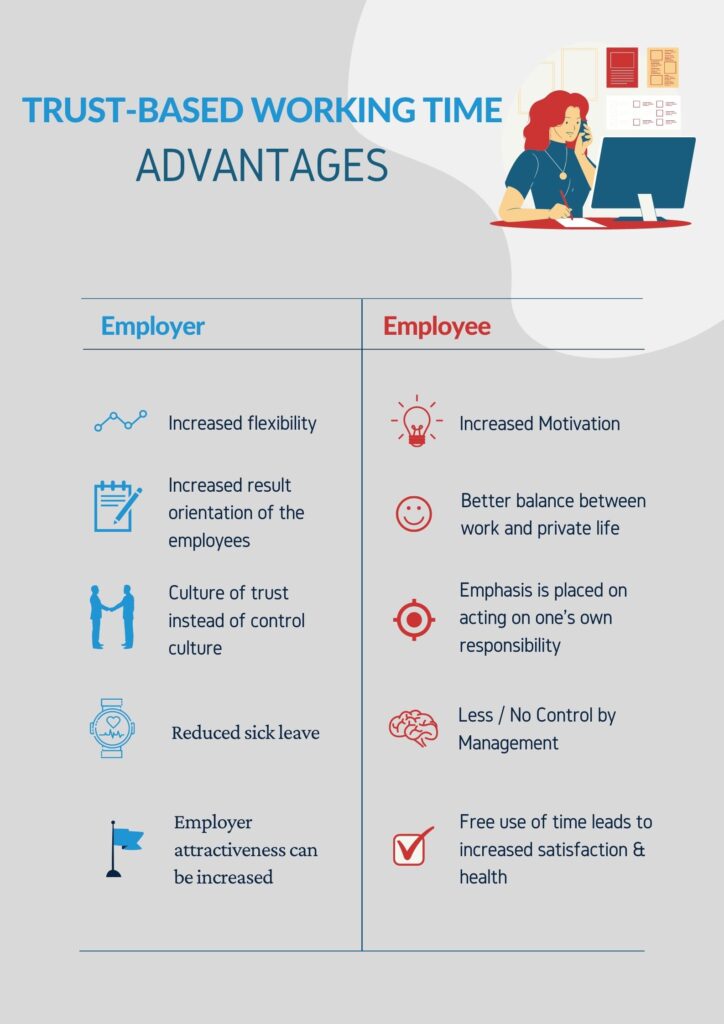
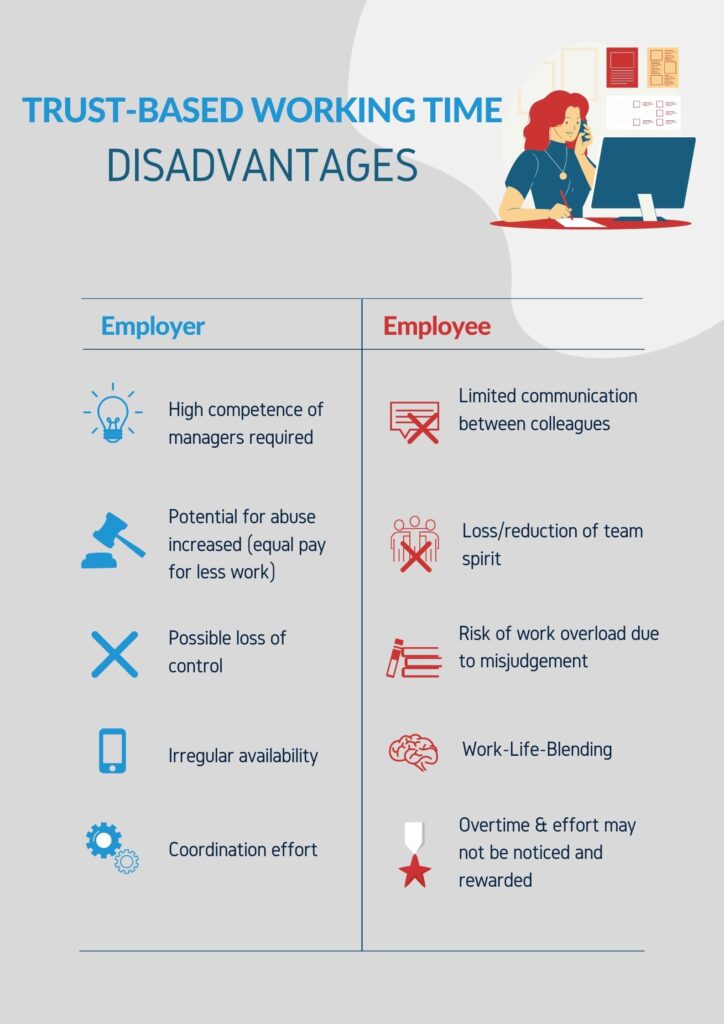
Trust-based working hours can be successful and promote a positive & motivated corporate culture. However, it can also have negative consequences – if implemented incorrectly.

Here are some advantages and disadvantages for employers and employees:

Trust Based Working Time Advantages

Trust-Based Working Time_Disadvantages

And Now? What Should I do?

Now the question is of course: should I or should I not give it a go? This form of work organisation offers many risks and opportunities. Of course, this model will be rather difficult or even impossible to implement in retail or hospitality. In these industries certain opening hours and working hours are essential. On the other hand, the model can be implemented very well in occupational groups that have little or no customer contact and can do their work independently. Working groups such as employees in the field, R&D or in the creative sector are particularly well suited.

👉 Do you have other HR & Payroll related questions or issues? Do not hesitate to contact us.

Ready to Transform Your HR & Payroll Operations?

Join hundreds of enterprises worldwide that trust Novative to expertly manage their HR and payroll processes.